





MEPs handed over to local governments to drive clean energy, sustainable development

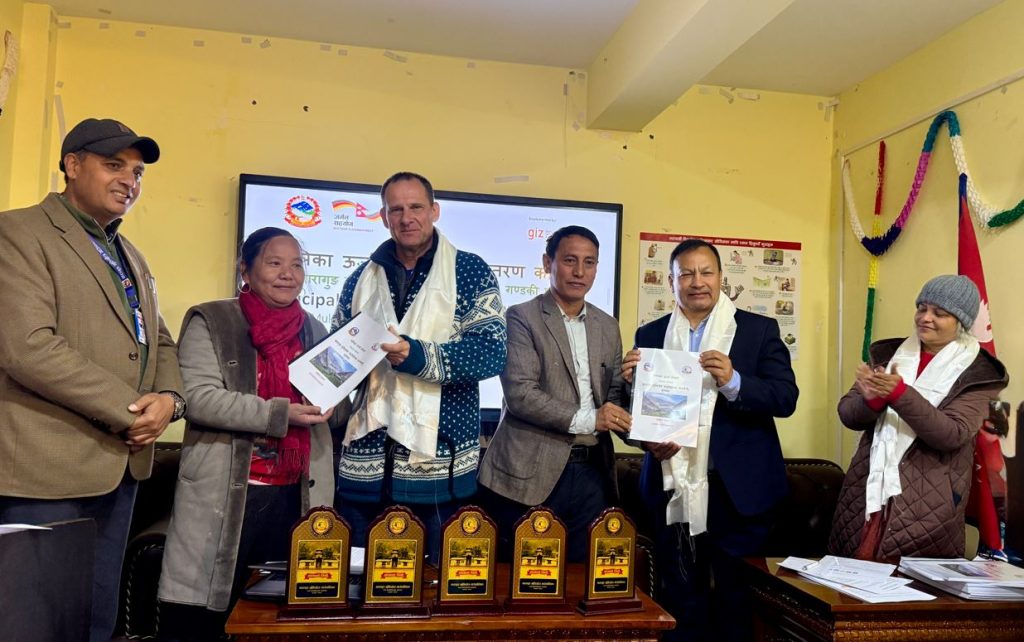
vvvvvMustang: As a significant step toward strengthening local energy planning and implementation, Municipal Energy Plans (MEPs) of Varagung Muktichhetra and Gharapjhong Rural Municipalities in Mustang have been formally handed over to the respective local governments.

The MEPs were developed by the Municipalities with technical support from the Renewable Energy and Energy Efficiency Programme – Green Recovery and Empowerment with Energy in Nepal (REEEP-GREEN) project.
Developed through extensive consultations with communities and stakeholders, the five-year plans provide a practical roadmap to address local energy challenges while promoting socio-economic development,
climate resilience and clean energy use, REEEP-GREEN Project stated in a press release today.
The handover events highlighted the growing recognition of energy as a cornerstone of local development, improved public services, and climate resilience. Through the MEPs, both municipalities aim to integrate energy planning systematically into their annual plans and broader development strategies.
The plans aim to increase the use of grid-connected electricity and renewable energy technologies to build healthier, more sustainable, and prosperous communities. Key priorities include improving substandard household wiring, reducing reliance on LPG for cooking through a gradual transition to electric cooking, promoting energy-efficient and clean energy–based tourism, and supporting the productive use of energy—particularly for women and marginalized groups.
The handover ceremonies were held at the Municipality offices on January 7 where Dr Ranjan Prakash Shrestha, Senior Project Manager at the European Union Delegation to Nepal and Dr Frank Fecher, Programme Manager at GIZ Nepal formally presented the MEPs to Rinzen Namgel Gurung, Chairperson of Varagung Muktichhetra Rural Municipality, and Mohan Singh Lalchan, Chairperson of Gharapjhong Rural Municipality.
The events were attended by elected representatives, municipal officials, community stakeholders and other representatives from the European Union and GIZ Nepal.
“The Municipal Energy Plan gives us a clear direction to move toward affordable, locally available, and cleaner energy solutions,” said Rinzen Namgel Gurung, Chairperson of Varagung Muktichhetra Rural Municipality. “We aim to implement these activities in collaboration with government agencies and development partners.”
The MEPs include detailed market-based cost estimates, ensuring that the proposed interventions are both technically feasible and economically viable. Varagung Muktichhetra Rural Municipality has estimated a total implementation budget of Rs 147.3 million, while Gharapjhong Rural Municipality has allocated Rs 218.9 million for a five-year period.
Chairperson Mohan Singh Lalchan of Gharapjhong Rural Municipality noted that the plan provides a
comprehensive overview of the rural municipality’s situation, priorities and investment needs, serving as a strong foundation for collaboration with government and development partners.
He also highlighted the importance of REEEP-GREEN–supported 21-day house wiring training for local youths, which will improve livelihoods while enhancing electrical safety in the community.
“Municipal Energy Plans are important tools, but their success depends on strong local ownership and implementation,” said Dr Shrestha from the European Union Delegation to Nepal. “These plans can help reduce dependence on imported fuels, lower household energy costs, and strengthen climate resilience in Mustang’s vulnerable communities.”
Alongside the MEP handover, the event marked the inauguration of the energy-retrofitted office room at Gharapjhong Rural Municipality office, demonstrating the practical application of energy efficiency measures in public buildings. The retrofit was implemented under the Building Energy Efficiency in Nepal (BEEN) project with financial support from the European Union.
The EU-GIZ team concluded their visit on January 9 with an observation of a recently completed hydro-powered lift irrigation system in Machhapuchhre Rural Municipality–5, Rivan, Kaski, supported under REEEP-GREEN project.
The system uses a Hypump-Turbine that harnesses the kinetic energy of flowing water, irrigating 7.5 hectares of higher-elevation farmland, benefiting 50 households that had previously relied solely on rainwater. Operating without electricity or fossil fuels, the system demonstrates a sustainable and climate-resilient irrigation solution.
During the visit, community members shared that access to reliable irrigation has already begun transforming their farming practices. The system has enabled a shift from subsistence, rain-fed agriculture toward diversified cash crop production, creating opportunities for increased household incomes and laying the foundation for stronger, more resilient local livelihoods.
About REEEP-GREEN
Renewable Energy and Energy Efficiency Programme – Green Recovery and Empowerment with Energy in Nepal (REEEP-GREEN) is a technical cooperation project between the Government of Nepal, the Federal Republic of Germany (BMZ) and the European Union (EU). The project promotes renewable energy and energy efficiency across Nepal.
The project has, among other activities, provided technical support to municipalities in formulating over 50 Municipal Energy Plans, promoted renewable energy solutions for socio-economic development, and implemented numerous renewable energy and energy efficiency initiatives in collaboration with public and private sector partners.








 अमेरिकालाई पठाइएको इरानको नयाँ प्रस्तावमा के छ ?
 खारेज भयो निजामती कर्मचारीको ट्रेड युनियन
 लिपुलेक हुँदै कैलाश मानसरोवर यात्राको विरोधमा सरकारले पठायो भारत–चीनलाई पत्र
 अमेरिकालाई ‘सम्झौता वा युद्ध’ एक रोज्न इरानको चेतावनी
 ‘होल्डिङ सेन्टर’का बालबालिकालाई निःशुल्क शिक्षा उपलब्ध गराउन आग्रह
 सुकुमवासीलाई चैत मसान्तभित्र व्यवस्थित बासस्थान उपलब्ध गराउन सरकारलाई रास्वपाको आग्रह
 सुनचाँदीको मूल्य वृद्धि, आजको कारोबारको मूल्य कति ?
 आज वैशाख शुक्ल पूर्णिमा: बुद्ध जयन्ती मनाइँदै
 सशस्त्र प्रहरी महानिरीक्षक अर्यालको फौजी परम्पराअनुसार बिदाइ
 देशका अधिकांश भागमा मेघगर्जनसहित वर्षाको सम्भावना
प्रतिक्रिया