





The Elusive Scavenger: Striped Hyena in the Shadows

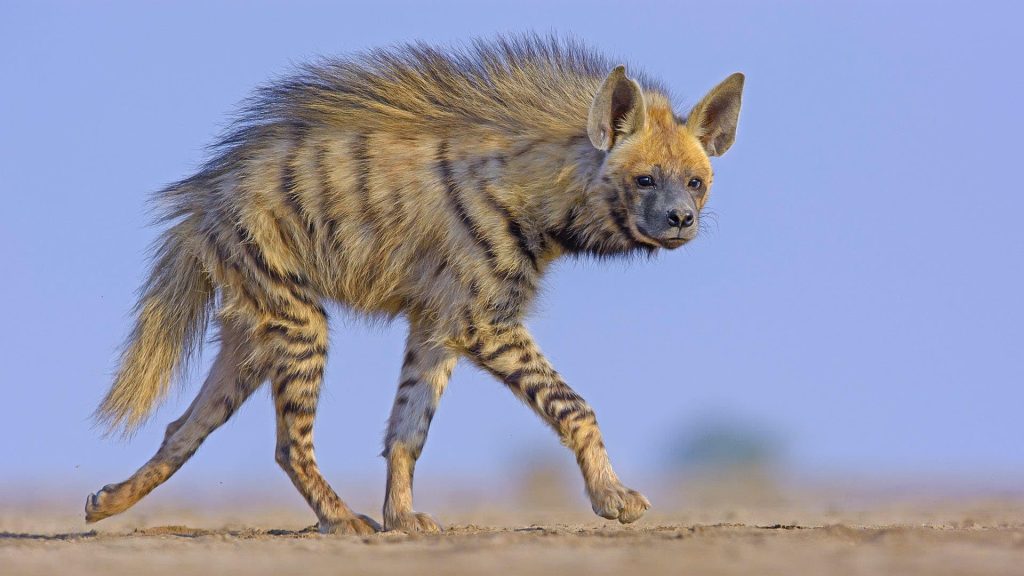
Kathmandu . The striped hyena (Hyaena hyaena Linnaeus, 1758) belongs to Hyaenaidae family. It is one of the endangered mammal species and is the only species found in Nepal belonging to family Hyaenidae and this family consists of other three members namely Aardwolf (Proteles cristata), Brown hyena (Hyaenabrunnea) and Spotted hyena (Crocuta crocuta) (Neupane et al. 2021). It is one of the least known large carnivore species. It plays a vital role in energy flow in an ecosystem due to its scavenging behavior (Kruuk, 1976). Common name of Striped Hyena (English) is हुँडार in Nepali.


Morphology
The striped hyena is a middle-sized predator with pointed ears, sloping back, thin legs and long, beige colored coat with black stripes on body and legs. It also has long dorsal hair and black patch on throat. Males are slightly larger than the female.
Reproductive Biology
Striped Hyena’s age at first reproduction is approximately 28 months. After a gestation period of 90 to 92 days, a litter of one to five young is born. It lives up to 24 years (recorded in captive animals) (Jnawali et al., 2011).
Social Behavior and Organization
They are majorly nocturnal, solitary animals and are rarely seen in pair. Mother tend to stay with offspring until they are grown-up. They produce giggling sound when frightened. They may growl or utter a lowly growl during food fighting. Their calls are softer than the spotted hyenas. They may form temporary breeding groups with one female and up to three males. These groups can stay together for several years, and the cubs may have different fathers. Both the mother and the males help take care of the young, showing bi-parental care (Drea, 2018).
A unique feature of the striped hyena’s hunting is the raised mane during pursuit. It is believed to have defensive mechanism of hyena to make it appear larger and dangerous when facing other carnivores (Kruuk, 1976).
Diet
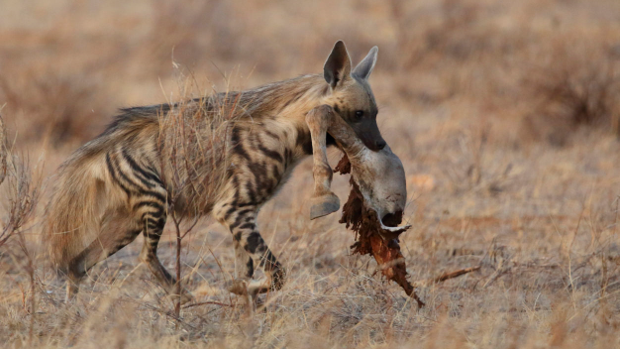
Striped hyena is omnivorous scavenger. It scavenges on carcasses of wild and domestic animals, such as Chital and Hog Deer. It has also been noted to feed on comparatively more vegetables than other hyena species and even fruits and insects (Jnawali et al., 2011 and Kruuk, 1976). They are known to feed on tortoises on desert (Kruuk, 1976). The striped hyenas found in hilly terrain feed on many ungulates and small mammals, which compose the main prey species for hyena and even the dens here provide cover for them (Bhandari at el., 2021).
Population Status
The total estimated population of striped hyenas all over the world is less than 10,000 individuals (Abi-Said & Abi-Said, 2007). The population of the Hyaena has been considered to be in decline and the current population in Nepal is estimated to be less than 100 individuals (Jnawali et al., 2011). However, little is known about its past and present occurrence in Nepal (Bhandari et al., 2016).
Ecological Role
The striped hyena, being at the apex of the food chain, influences the ecosystem structure and function despite their low densities in population (Bhandari et al., 2016). It performs an essential function in the ecosystem as a scavenger as it prevents the spread of infectious diseases and contributes to maintain a healthier environment by feeding on carcasses and organic waste.
Conservation Status
Its global status is near threatened and national status is endangered. It is listed in the National Parks and Wildlife Conservation Act 2029 (1973) as protected priority species (Jnawali et al., 2011). Hyena is one of the twenty seven mammals species protected by National Park and Wildlife conservation ACT- 1973 of Nepal (Khanal et al., 2017).
Distribution
The distribution area of the striped hyenas, primarily solitary and nocturnal scavengers are found over widespread geographic range extending from tropical and sub-tropical regions of Africa to middle and south Asia. (Bhandari et al. 2017). The Striped Hyena occurs in grasslands, dense forest and undulating grounds (Jnawali et al., 2011).
The Striped Hyena is distributed in the Terai region of Nepal within the protected areas of Bardia National Park, Chitwan National Park, Parsa Wildlife Reserve and Shukla Phanta Wildlife Reserve. Outside of protected areas they have been recorded in the districts of Bara, Kailali, Kapilbastu (Niglihawa VDC), West of the Bagmati to Kanchanpur (Jnawali et al., 2011).
The Chure hills and the Terai regions hold the largest extent of hyena habitat in Nepal (Bhandari et al. 2022). In central Terai, Hyenas are mostly sighted in the Sal forest and on agricultural land (Bhandari et al., 2016). At the south eastern lowlands of Nepal, hyenas are mostly found on the grasslands and riverbeds. High hyena frequencies in grasslands and riverbeds in proximity to human settlements and water sources is because of easy food and water availability (Bhandari et al., 2021).
Even though hyena is mostly found in Terai in Nepal, they were also found in hilly regions namely Kalikot and Jajarkot of Western Nepal (Bhandari et al., 2017).
Threats
Striped hyenas are under the continuous pressure of several threats that directly or indirectly affect their occurrence and abundance. They are sensitive to habitat loss and fragmentations because of their large territories, high mortality rates and are declining in many places owing to persecution (poisoning, killing and hunting), habitat alteration and destruction and as a result of decreasing natural sources of food (Alam et al., 2015 and Bhandari et al.,2016).
The high dependency of the local people on the natural forests especially government managed forests is affecting the population of prey species and is causing threat to survival of hyenas (Bhandari et al., 2017).
Human wildlife conflict is the main reason for decline in population of hyena along with other small carnivores. Especially with the striped hyena which is well known for its omnivorous nature; presents higher probability for confrontation with humans. There is large gap in our knowledge on several aspects of the striped hyena behavior and its ecology such as competition with other carnivores, effect of habitat degradation and climate change.
In many cultures, these elusive scavengers are linked with black magic. As dried striped hyena skin has been used as a powerful spell in Iran. In Afghanistan and Pakistan, striped hyena’s hair is used to treat disease and for the magic of love i.e. used to cast love spell or enhance romantic power. Its blood has been exploited as a potent medicine in northern India, and eating hyena tongue has been believed to help fight tumors. Its right ear is said to have healing properties according to African folklore (Nouri et al., 2023). These cultures contribute to poaching and trade of hyaenas.
Conservation Urgency
Having been named the protected mammal of Nepal, but there are too little information about the ecology, denning activities and threats to the species in the country. Thus, further research on the ecology, behavior and conservation awareness from the grass root level is necessary (Khanal et al., 2017).
Nocturnal habit, solitary behavior, and difficult terrain habitat of striped hyena make it difficult to conduct surveys and research on its actual population status. Similarly, most of the research and conservation activities are confined to flagship species in Nepal (Asmit et al., 2021).
The population dynamics and ecological niche of striped hyena is urgently needed to be documented in Nepal (Bhandari et al., 2017).
To make people understand their value, awareness programs must be organized in the local level. In the most conflicting sites, compensation programs should be launched that would be helpful to save striped hyena’s population in Nepal. The population dynamics and ecological niche of striped hyena is urgently needed to be documented in Nepal. Moreover, the prey population should be conserved and habitat destruction should be controlled (Bhandari et al., 2017).
References:
Abi-Said, M. R., & Abi-Said, D. M. (2007). Distribution of striped hyaena (Hyaena hyaena syriaca Matius, 1882) in urban and rural areas of Lebanon. Zoology in the Middle East, 42(1), 3–14. https://doi.org/10.1080/09397140.2007.10638241
Alam, S., Khan, J. A., & Pathak, B. (2015). Striped hyena (Hyaena hyaena) status and factors affecting its distribution in the Gir National Park and Sanctuary, India. Folia Zoologica, 64(1), 32–39. https://doi.org/10.25225/fozo.v64.i1.a4.2015
Bhandari, S., & Bhusal, D. R. (2017). Notes on human-hyena (Hyaena hyaena, Linnaeus 1751) conflict in Jajarkot, Kalikot and Mahottari districts of Nepal. Journal of Institute of Science and Technology, 22(1), 127–131. https://doi.org/10.3126/jist.v22i1.17763
Bhandari, S., & Chalise, M. K. (2016). People’s attitudes toward striped hyaena (Hyaena hyaena Linnaeus, 1758) conservation in lowland Nepal. Journal of Threatened Taxa, 8(9), 9125–9130. https://doi.org/10.11609/jott.2518.8.9.9125-9130
Bhandari, S., Adhikari, B., Baral, K., Youlatos, D., Panthi, S., Kunwar, R. M., Thapamagar, T., Psaralexi, M., & Bhusal, D. (2022). Climate change threatens striped hyena (Hyaena hyaena) distribution in Nepal. Hystrix, the Italian Journal of Mammalogy, 33(1), 58–64. https://doi.org/10.1007/s13364-022-00638-2
Bhandari, S., Bhusal, D. R., Psaralexi, M., & Sgardelis, S. (2021). Habitat preference indicators for striped hyena (Hyaena hyaena) in Nepal. Global Ecology and Conservation, 30, e01619. https://doi.org/10.1016/j.gecco.2021.e01619
Bhandari, S., Rijal, B., & Khanal, S. (2017). Status of striped hyena (Hyaena hyaena Linnaeus, 1758) and their conservation approaches in Rautahat and Sarlahi forests, Nepal. Journal of Natural History Museum, 29, 97–107. https://doi.org/10.3126/jnhm.v29i0.19037
Drea, C., Coscia, E. M., & Glickman, S. (2018). Hyenas. In M. Skinner (Ed.), Encyclopedia of Reproduction (2nd ed., pp. 637–645). Academic Press.
Jnawali, S. R., Baral, H. S., Lee, S., Acharya, K. P., Upadhyay, G. P., Pandey, M., Shrestha, R., Joshi, D., Lamichhane, B. R., Griffiths, J., Khatiwada, A., & Amin, R. (Eds.). (2011). The status of Nepal mammals: The National Red List Series. Department of National Parks and Wildlife Conservation.
Khanal, C., Baniya, S., & Acharya, M. (2017). First confirmed record of striped hyaena (Hyaena hyaena) den in Nepal. Journal of Biodiversity and Endangered Species, 5(1), 195. https://doi.org/10.4172/2332-2543.1000195
Kruuk, H. (1976). Feeding and social behaviour of the striped hyaena (Hyaena vulgaris Desmarest). African Journal of Ecology, 14(2), 91–111. https://doi.org/10.1111/j.1365-2028.1976.tb00155.x
Neupane, A., Regmi, A., Tiwari, A., Sharma, B., Adhikari, A., & Neupane, B. (2021). Status, distribution, and threats of striped hyena (Hyaena hyaena Linnaeus, 1758) in Nepal: A review. Indonesian Journal of Social and Environmental Issues, 2(3), 92–99. https://doi.org/10.47540/ijsei.v2i3.337
Nouri, F. M., Hemami, M. R., Rezvani, A., & Ghasemi, B. (2023). The influence of superstitions and emotions on villagers’ attitudes towards striped hyena in southwestern Iran. PLOS ONE, 18(5), e0285546. https://doi.org/10.1371/journal.pone.0285546












 स्वास्थ्यमन्त्री मेहतासँग र एडिबीका देशीय निर्देशकको शिष्टाचार भेट
 जापानको उत्तरी क्षेत्रमा शक्तिशाली भूकम्प, ८० सेन्टिमिटरको सुनामीको लहर कुजीमा ठोक्कियो
 ‘बोरिङ लिफ्ट’ खानेपानी आयोजना निर्माण सुरु
 विश्वविद्यालयबाट विद्यार्थी र कर्मचारी संगठन हटाउन प्रधानमन्त्रीको निर्देशन
 रास्वपा महामन्त्रीमा भूपदेव शाह
 नेपाल धितोपत्र बोर्डको अध्यक्ष श्रेष्ठले दिए राजीनामा
 मौसम पूर्वानुमान : आज यी ६ प्रदेशमा चट्याङ्गसहित वर्षाको सम्भावना
 विद्यालय शिक्षा ऐन छिटो ल्याउन मन्त्री पोखरेललाई आग्रह
 चर्कियो तनाव : होर्मुजमा इरानद्वारा तेल ट्यांकरमाथि आक्रमण
 आइतबार र शनिबारको सार्वजनिक बिदा अस्पतालमा पनि लागू गर्ने निर्णय
प्रतिक्रिया